Harvester Payroll began with an ordinary request from a sugar-cane farmer. But the name has always carried a second meaning: the harvest fields of the farming community, and the people whom Jesus calls us to love and reach with the good news.
“I tell you, open your eyes and look at the fields! They are ripe for harvest.”
John 4:35
This is the story of a family, a surprising software business, and a journey from the farms around Mazabuka to modern payroll technology — while continuing to serve rural communities in Zambia.
Stars, screens and clean water — an illustration prepared for the original Harvester story.
1996Sean and Joanne arrive in Mazabuka to serve rural communities
1999The first Excel payroll program is built for a sugar-cane farmer
2000Harvester Payroll is established in Zambia
2015Harvester Payroll Online launches after two years of development
TodayOnline, offline, mobile-payment exports and optional AI reporting
Chapter 01 · An unexpected beginning
We came to Zambia for people, not programming
When my wife, Joanne, and I arrived in Mazabuka during a very wet and muddy January of 1996, starting a payroll software business was the last thing on my mind. We had been married for just over a year and had been sent by our local church in Johannesburg to serve among the Tonga people in rural Zambia.
Our purpose was to share the good news of Jesus Christ, make disciples, build relationships and become part of the communities we had come to love. I had studied information technology, but a short mission trip to Luapula Province had changed the direction of my life. Rather than pursuing a career writing COBOL, I was learning Tonga.
I did not realise that learning languages — human and computer — would become such a recurring theme in our lives.
Chapter 02 · A practical problem on a farm
It started with a sugar-cane farmer called Johno
Towards the end of 1999, John Taylor — “Johno” to everyone who knew him — asked whether I could help. Like many farmers around Mazabuka, he spent hours every month preparing employee payslips using Excel, calculating deductions and compiling statutory pension and tax returns.
Over about two weeks I wrote a simple payroll program using Visual Basic for Applications within Microsoft Excel. It could prepare payslips and pension reports much more quickly, using software farmers already had.
Johno liked the program. And then he started talking to other farmers.
Why farming mattered: Most of Harvester's first customers worked in agriculture. Farming employers dealt with different wage arrangements, allowances, loans, advances, casual workers and payroll reporting requirements. Their practical problems shaped the software from its earliest days.
By 2000, what had begun as a favour was becoming a business: Harvester Payroll. The name felt natural because its earliest users worked among fields and harvests. But, for our family, it also spoke of the harvest Jesus describes in John 4:35.
Chapter 03 · Farm radios and people
When the farm radio became our advertising department
Long before social media, farming communities around Mazabuka used radio communication to stay in touch. Word of Johno's payroll program spread over the farm radios, and suddenly my own radio call sign became rather busy.
No two farms were quite the same. One needed a different allowance; another had special deductions or employee advances. I spent hours adjusting the program so it worked for the people who used it. That experience helped us build a more flexible system for Zambia.
A lesson learned from one wrong digit
In the early years I sometimes included an encouraging Bible verse in the program for a new customer. On one occasion, I intended to give Sue, who managed payroll at a maize and chicken farm, Philippians 4:19. By mistake, I entered Philippians 3:19 — a very different verse!
She checked her Bible and asked whether I was quite sure. It was a memorable lesson in the importance of accuracy: one character can change the meaning completely. That lesson matters in software, in payroll and in how we communicate with people.
Learning the language of the user
I also remember training Kodak, the personnel officer at Mubuyu Farm, then a large coffee farm. I tried to communicate in Tonga wherever possible. Ordinary conversation was one thing; explaining all the details of a payroll system was quite another.
It taught me that clever software is of little value if the person using it cannot understand it. The goal has always been to make payroll more practical for the user, not merely more impressive to the programmer.
Chapter 04 · The changing language of technology
From Excel to Windows, the web, and artificial intelligence
As Harvester grew, the original Excel program became a full Windows payroll system. By 2013, however, the internet was changing how businesses operated. I had to learn PHP, JavaScript and more about MySQL — an entirely new world after years of desktop programming.
We spent much of 2013 and 2014 developing the online system. Harvester Payroll Online launched in 2015. Not every customer was delighted at the thought of moving away from a familiar offline program. And operating a live online service came with its own challenges. When something went wrong, the phone certainly rang!
Over time, better internet access, WhatsApp customer support, PDF and e-payslips, employee self-service and practical payment exports helped make online payroll more useful to employers.
Payday in a maize field
A farmer near Mkushi, Raubie Gravensteyn, described something that has stayed with me. When his wife processed salary payments through MTN Mobile Money, women working in the seed-maize fields would begin hearing their phones ping as their wages arrived — one after another, across the field.
That is technology at its best: not complicated for its own sake, but making an ordinary part of working life easier. Harvester now supports preparation of payroll payment files for supported mobile-money and banking workflows, alongside traditional payroll reports.
Excel and WindowsPractical local payroll, employee records, payslips and reports shaped by Zambian employers.
Online and mobileAccess through the browser, electronic payslips, employee self-service and supported salary-payment files.
AI-assisted workflowsOptional read-only payroll reporting and help preparing attendance spreadsheets for human review.
Another new language: AI
Today, artificial intelligence offers new possibilities, from helping an administrator interpret a photographed timebook into a spreadsheet, to asking questions about recorded payroll costs and preparing draft accounting journals. These are tools to assist people, not replace their judgement.
Harvester's optional AI Reporting connection is read-only; it does not change salaries, authorise payments or post accounting entries. Just as with Johno's spreadsheet in 1999, the real question is whether the technology solves a practical problem.
Our primary reason for coming to Zambia was, and remains, sharing the good news of Jesus Christ and helping establish healthy churches in rural communities. The programming work that began with Johno provided an unexpected way for our family to remain in Zambia and continue that calling.
To be clear, Harvester Payroll does not directly fund our outreach programmes through Mazabuka Community Church. The business has nevertheless played an important role in enabling our family to continue living and serving here.
From heavy film reels to a projector in a backpack
In the 1990s we showed the Jesus Film in Tonga using a 16mm film projector and four large reels. Transporting the projector, amplifier and other equipment was a major task. Then came VHS, DVDs and, eventually, compact battery-powered LED projectors.
What once required heavy equipment and considerable expense can now fit into a small backpack — and be carried to a village by bicycle. We can still share the same story in a language people understand.
Illustration of an outdoor film screening, prepared for the Harvester story.
Where the dirt road ends: Namaila
One community where we remain involved is Namaila, roughly 70 kilometres from Mazabuka near the Zambezi Escarpment. I first arrived there on a mountain bike and met the local headman. That chance encounter opened a lasting relationship.
When we discussed safer drinking water for the village and school, the headman raised another concern: “Kunyina network kuno mu Namaila! Tuchite buti?” — “There is no network here in Namaila! What are we going to do?” Even in a remote place, mobile connectivity mattered deeply.
His son, Vious Chiyama, explained how he sometimes climbed a rocky outcrop hoping to pick up a phone signal. Later, Vious and a friend showed me how to access the Tonga Bible and audio through the YouVersion app. After years of training people to use computers, I was the one learning something new.
Illustration associated with the rural water-project part of the story.Illustration of an outdoor village screening. Original photographs can be substituted.
Water for life
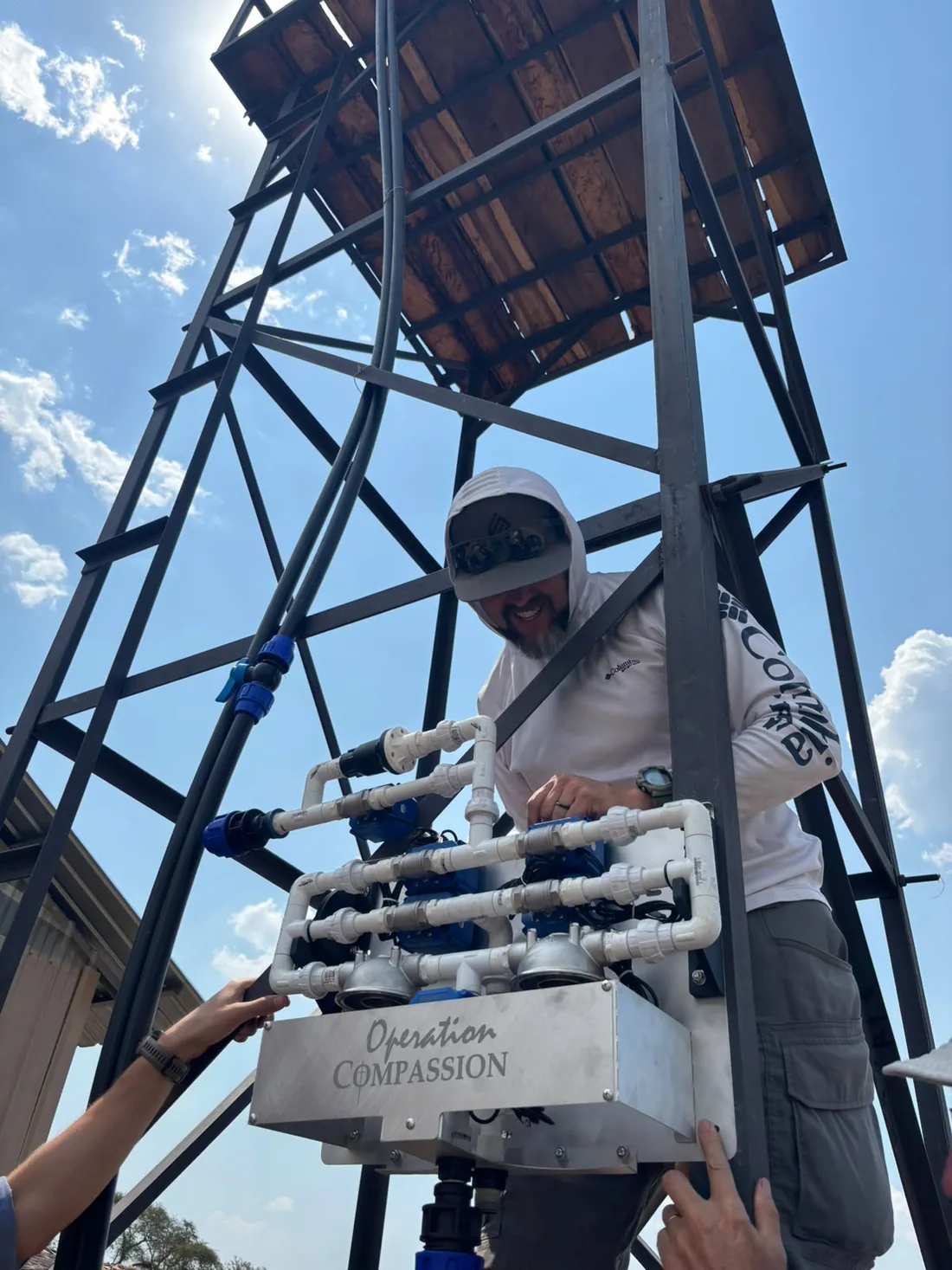
Working alongside partners such as Operation Compassion, members of our church have been involved in efforts to improve access to safer drinking water in rural communities. Clean water matters for people's health and wellbeing; it also reflects our desire to demonstrate love through practical service.
In John chapter 4, Jesus speaks to a Samaritan woman at a well about living water. That passage connects deeply with our work: caring for physical needs and sharing the hope of the gospel belong together for us.
Chapter 06 · A name with two meanings
Why we called it Harvester
There were two harvests in view when the Harvester name took shape.
The fields of ZambiaOur first customers were largely farmers. Their practical needs — employee wages, payslips, deductions and statutory returns — gave the software its roots.
The harvest Jesus spoke aboutJohn 4:35 reminds us of people ready to hear the good news. Our faith and desire to serve people have always been part of our family's purpose in Zambia.
The two meanings are not a sales pitch. They are simply an honest explanation of where the business came from and why the name remains meaningful to us.
We are grateful to the farmers who gave Harvester its beginning, to the businesses and organisations throughout Zambia that use it today, and to the many people who have shared the journey with us.
From Mazabuka to the future
Good software should serve people.
In 1999, a farmer wanted to spend less time preparing payslips. More than a quarter of a century later, Harvester continues developing practical payroll tools for Zambian employers — while our family continues to value relationships, faith and service in rural communities.
However advanced technology becomes, the most important thing is not the language of the machines, but our willingness to understand, love and serve the people around us.
Sean Kelly · Founder and developer, Harvester Payroll
Harvester Payroll is a Zambia-based software business established in 2000. This page tells its founder's story; it is not a fundraising page. The illustrated images can be replaced with original photographs using the same filenames.